
How to Select DINP, DOTP, or DPHP for Flexible PVC Cable Sheathing in Mexico
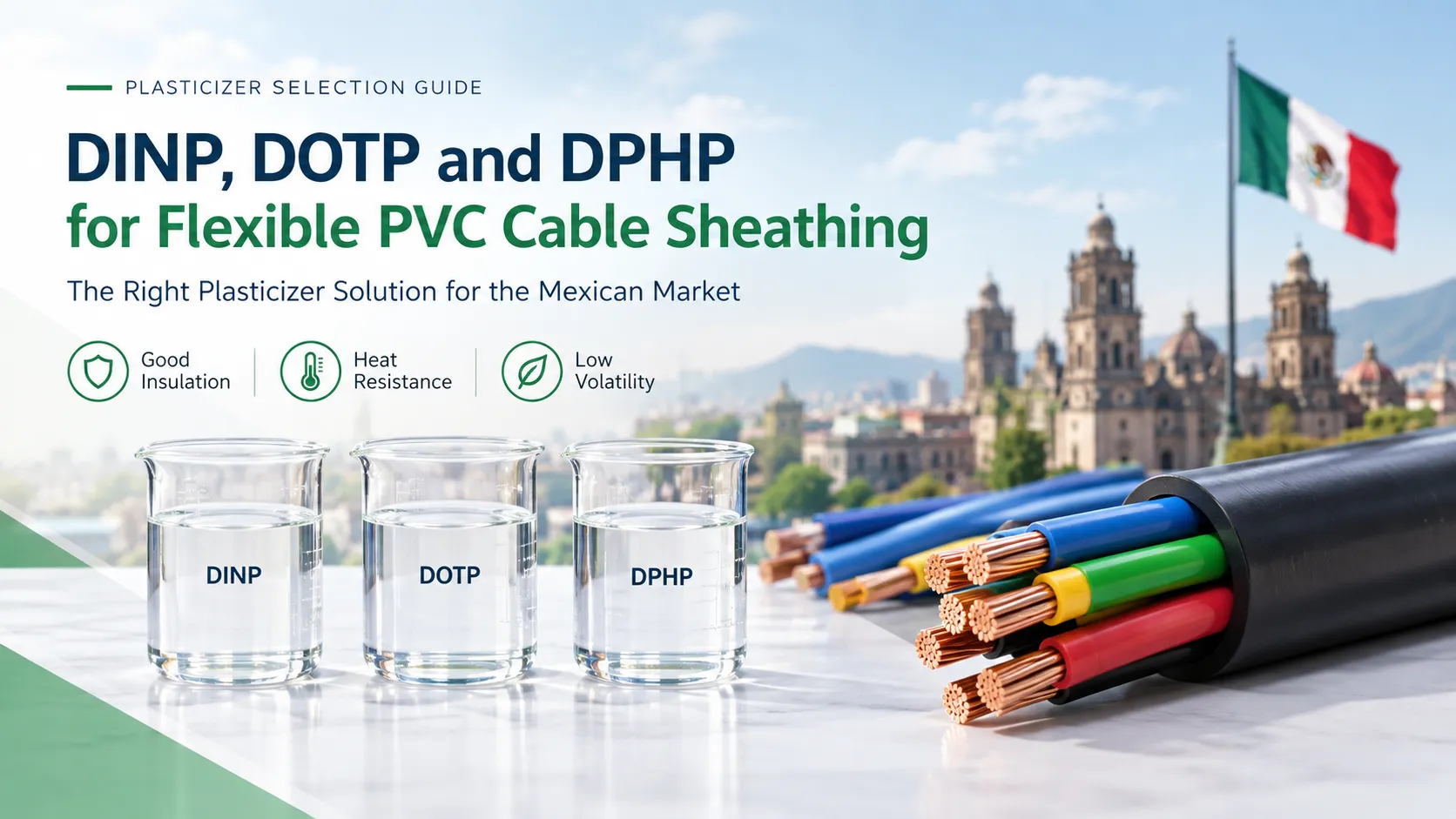
Selecting a plasticizer for flexible PVC wire and cable sheathing requires more than comparing a single physical property. The right choice should reflect the cable’s required operating temperature, flexibility target, extrusion conditions, migration and volatility requirements, formulation economics, and the compliance obligations of the final destination market.
For cable compound manufacturers in Mexico, Henan GO Biotech Co., Ltd. provides DINP, DOTP, and DPHP options for structured formulation evaluation. This page outlines a practical way to assess these plasticizers for flexible PVC cable sheathing without treating any single material as a universal replacement for another.
Start with the cable sheath performance requirement
Flexible PVC cable sheathing must protect the conductor and insulation system while retaining suitable flexibility during production, installation, and service. Plasticizer selection affects the processing behavior of the PVC compound as well as finished-sheath properties such as softness, surface condition, resistance to migration, thermal aging behavior, and long-term stability.
DINP as a balanced option for flexible PVC cable sheathing
DINP (Diisononyl Phthalate), CAS No. 28553-12-0, is a general-purpose high-molecular-weight phthalate plasticizer with the molecular formula C₂₆H₄₂O₄. It is a clear, colorless oily liquid designed for flexible PVC and related polymer applications.
For PVC cable sheathing, DINP offers good compatibility with PVC resins and balanced flexibility, low volatility, and migration resistance. It is suitable for conventional rubber and plastics processing methods, including extrusion, calendering, and injection molding. The stated processing range is 160–190°C; actual compound settings should be confirmed through plant trials and formulation validation.
Where DINP may fit in a cable compound
- Flexible PVC wire and cable sheathing requiring a balanced general-purpose plasticizer profile.
- High-volume extrusion programs where stable PVC compatibility and consistent processability are important.
- Formulations requiring improved volatility and migration control compared with traditional DOP-based systems.
- Cable applications with baseline heat-aging and weather-resistance needs, subject to finished-compound testing.
- Blended systems in which DINP is used with compatible plasticizers to adjust cost, thermal performance, low-temperature flexibility, or migration behavior.
A practical DINP, DOTP, and DPHP selection framework
DINP, DOTP, and DPHP should be evaluated as formulation tools rather than interchangeable commodities. A useful comparison begins with the cable design requirement and then considers how each plasticizer performs within the complete PVC formulation, including resin grade, filler system, stabilizer package, additives, and extrusion parameters.
| Evaluation point | DINP | DOTP | DPHP |
|---|---|---|---|
| Primary decision role | Balanced general-purpose high-molecular-weight phthalate option for flexible PVC. | Evaluate where a non-phthalate plasticizer route is required by the specification or market. | Evaluate where the cable design places stronger emphasis on high-temperature performance and low volatility. |
| Processing review | Good PVC compatibility; stated DINP processing range is 160–190°C. | Verify fusion, viscosity, extrusion output, and surface quality in the intended formulation. | Verify processing behavior against the specific temperature profile and line conditions. |
| Migration and volatility | Designed to provide low volatility and good migration resistance for flexible PVC use. | Compare against the customer’s migration, fogging, and aging test requirements. | Assess when low volatility and high-temperature aging are priority criteria. |
| Compliance pathway | Confirm whether a phthalate-based plasticizer is permitted for the final cable application and export destination. | Review customer, regional, and end-use requirements for non-phthalate formulations. | Confirm applicable substance and product requirements before finalizing the formulation. |
| Cost assessment | Assess total formulation cost together with process efficiency and target performance. | Compare total formulation economics, not only the plasticizer purchase price. | Evaluate against the value of higher-temperature or lower-volatility performance requirements. |
The table is a decision guide, not a substitute for compound development, laboratory testing, cable-standard verification, or customer approval.
Compliance considerations for Mexico-produced cable compounds
Mexico-based cable production may serve domestic projects, regional supply chains, or export markets with different product and chemical requirements. The country of manufacture alone does not determine plasticizer suitability. The final decision should be linked to the cable’s intended use, the applicable cable specification, and the requirements of the destination market.
- Identify the required continuous operating temperature and relevant heat-aging test conditions.
- Confirm restrictions applicable to the finished cable application, including end-use and destination-market chemical requirements.
- Review customer documentation requirements, such as technical data, safety information, declarations, and test records.
- Validate the finished PVC sheath for mechanical, electrical, thermal, migration, and aging characteristics required by the applicable standard.
Formulation and extrusion validation sequence
- Define the cable specification. Establish sheath thickness, flexibility, operating temperature, electrical requirements, intended environment, and export destination.
- Screen the plasticizer route. Compare DINP, DOTP, and DPHP against the specification, including whether phthalate or non-phthalate chemistry is appropriate for the intended market.
- Develop the complete compound. Evaluate the selected plasticizer with the chosen PVC resin, stabilizers, fillers, pigments, lubricants, and other formulation components.
- Run processing trials. Review fusion behavior, torque, melt stability, extrusion output, surface appearance, and any deposit formation under actual line conditions.
- Verify finished-cable performance. Test against the applicable customer and cable-standard requirements before production release.
DINP supply and handling information
| Product | DINP, Diisononyl Phthalate |
| CAS No. | 28553-12-0 |
| Available packaging | 200 kg steel drums, 1,000 kg IBC totes, and flexitanks |
| Storage | Store in a cool, ventilated indoor area in sealed original packaging. Keep away from open flames, high-temperature equipment, acids, alkalis, flammable materials, and corrosive chemicals. Prevent water and dust contamination. |
| Shelf life | 12 months under standard storage conditions |
Selection principle: DINP can be a practical choice for flexible PVC cable sheathing where balanced flexibility, PVC compatibility, low volatility, and migration resistance are required. DOTP or DPHP should be considered when the formulation, service conditions, or destination-market requirements call for a different compliance or performance profile. Final selection should always be validated in the finished cable compound.
Henan GO Biotech Co., Ltd. supports B2B customers with DINP and other plasticizer options for PVC compound evaluation. For Mexico cable sheath projects, provide the target cable application, operating-temperature requirement, export destination, applicable standard, and planned formulation conditions so the material review can be aligned with the actual manufacturing and compliance context.


