
How to Read a Plasticizer COA: A Buyer’s Guide to Batch Quality and Reliable Sourcing
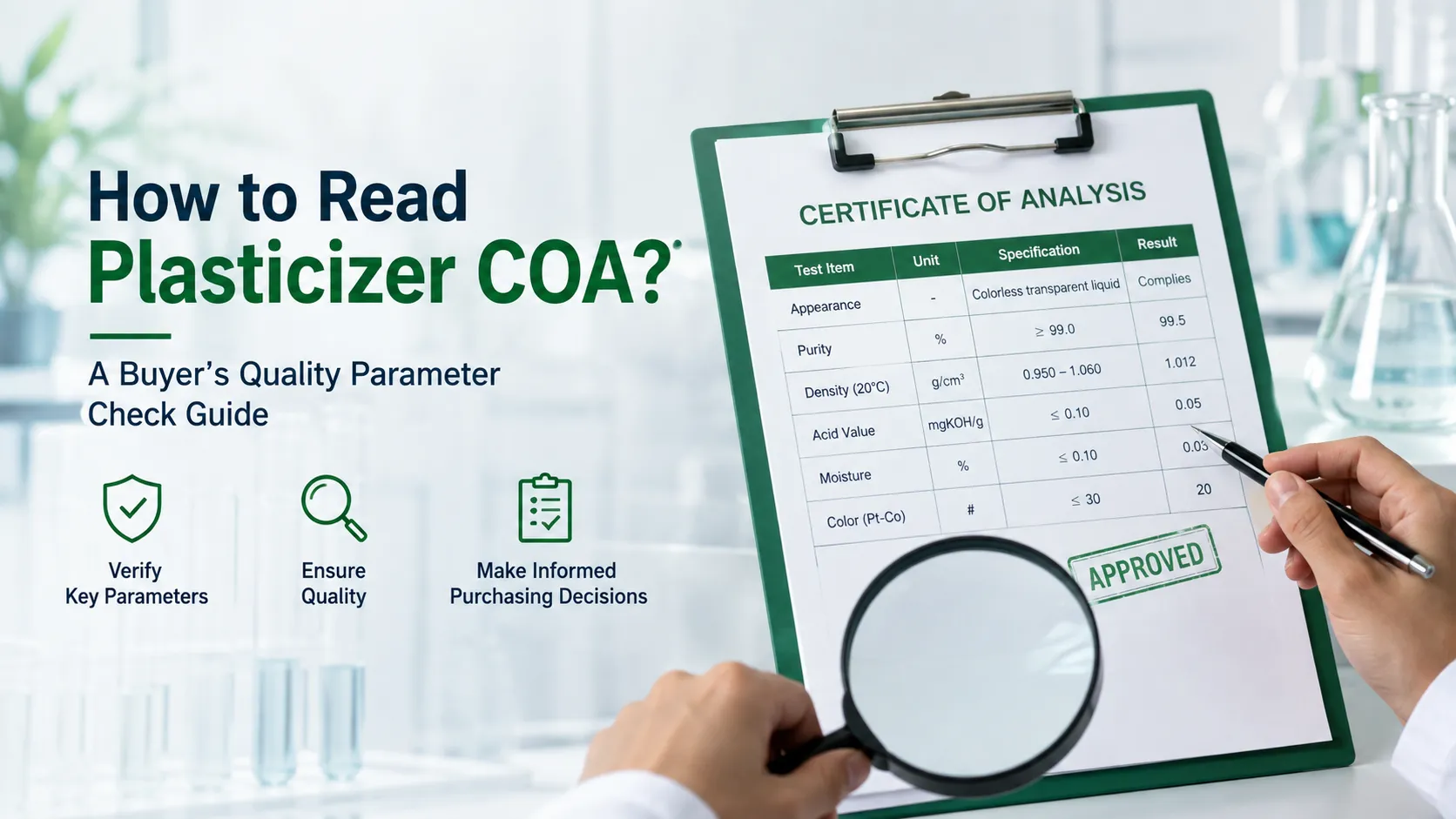
For international buyers of DOTP, DINP, DPHP, DOA, TOTM, and other ester-based plasticizers, a Certificate of Analysis (COA) is one of the most useful documents to review before approving a shipment. It records the tested results for a specific production batch and helps purchasing, technical, and quality teams confirm whether the material meets the agreed specification.
A reliable plasticizer COA supports procurement decisions, but it should not be treated as the only qualification tool. For PVC compounds, wire and cable insulation, flexible films, automotive interiors, coatings, inks, and rubber products, buyers should evaluate batch data together with technical documentation, safety information, and representative application testing.
What a Plasticizer COA Shows
A COA is a batch-specific quality record rather than a general product introduction. A complete document normally identifies the material and links its laboratory results to the goods being supplied.
Buyers should first verify that the COA batch number matches the packing list, drum, IBC, flexitank, or bulk shipment identification. A report that cannot be clearly connected to the delivered batch provides limited traceability value.
Quality Parameters That Matter in Plasticizer Batch Testing
Required test items vary by product grade and end use. For example, a PVC cable plasticizer may require close attention to electrical properties, while a low-volatility plasticizer for automotive PVC may be assessed more heavily for volatility-related performance. The following indicators are commonly reviewed on a plasticizer COA.
Ester Content and Acid Value
Ester content is an important composition and purity reference for many ester plasticizers. Acid value indicates the level of acidic substances present. Both values should be assessed against the agreed product specification, not against a generic number from another grade or supplier.
Density and Appearance
Density helps with product identification, formulation calculations, and consistency review. Appearance and color are especially relevant for transparent PVC film, light-colored compounds, coatings, and applications where visual cleanliness or low color variation is required.
Flash Point and Water Content
Flash point is relevant to storage, handling, transport planning, and plant safety procedures. Water content should remain within the product requirement because excess moisture may affect PVC processing behavior and formulation stability.
Volume Resistivity and Volatility
Volume resistivity is a useful reference when selecting plasticizers for PVC wire and cable insulation. Volatility is often a priority for cable compounds, automotive interiors, and applications seeking lower emissions or improved retention during service.
How to Compare COAs from Different Plasticizer Suppliers
A single favorable report does not automatically demonstrate long-term supply reliability. When comparing a DOTP COA supplier or evaluating a new environmentally focused plasticizer source, compare equivalent grades under equivalent test conditions. An actual result should always be interpreted within its stated specification range; higher or lower is not necessarily better.
- Confirm the exact product grade: Do not compare data from different molecular structures or application grades as if they were interchangeable.
- Review the test method: The method, unit, and reporting format should be clear enough for technical teams to make a meaningful comparison.
- Check multiple batches: Historical COAs are valuable for reviewing batch-to-batch consistency rather than only one production result.
- Match documentation to shipment: Lot numbers, dates, quantities, and packing identification should support traceability.
- Validate in the actual formulation: Test the material with the intended PVC resin, stabilizer package, processing temperature, and plasticizer dosage before full-scale approval.
COA, TDS, and SDS Have Different Roles
| Document | Primary Purpose | Buyer Use |
|---|---|---|
| COA | Actual results for one batch | Shipment release and quality verification |
| TDS | Typical technical properties | Product selection and formulation review |
| SDS | Safety, storage, and handling information | EHS, transport, and operational planning |
None of these documents alone can guarantee finished-product performance. Final PVC properties depend on the entire formulation and manufacturing process, including resin type, additives, processing equipment, and operating conditions.
Build a More Reliable Plasticizer Qualification Process
For new supplier approval and bulk purchasing, a practical evaluation sequence is: COA review + TDS review + SDS review + representative sample testing + multi-batch consistency verification. This process helps reduce sourcing risk and supports more confident decisions for PVC compounds, cable materials, films, coatings, inks, and rubber applications.
Henan GO Biotech Co., Ltd. provides conventional and environmentally focused plasticizers, including DOP, DOTP, DINP, DPHP, DOA, TOTM, ESBO, ATBC, TBC, EFAME, DEHCH, and TEC. Global customers may request product-specific technical documents, available batch COAs, and samples for application evaluation. Contact our team to discuss your material specification, packaging needs, and intended end-use requirements.


Hot Products


Popular Articles


